
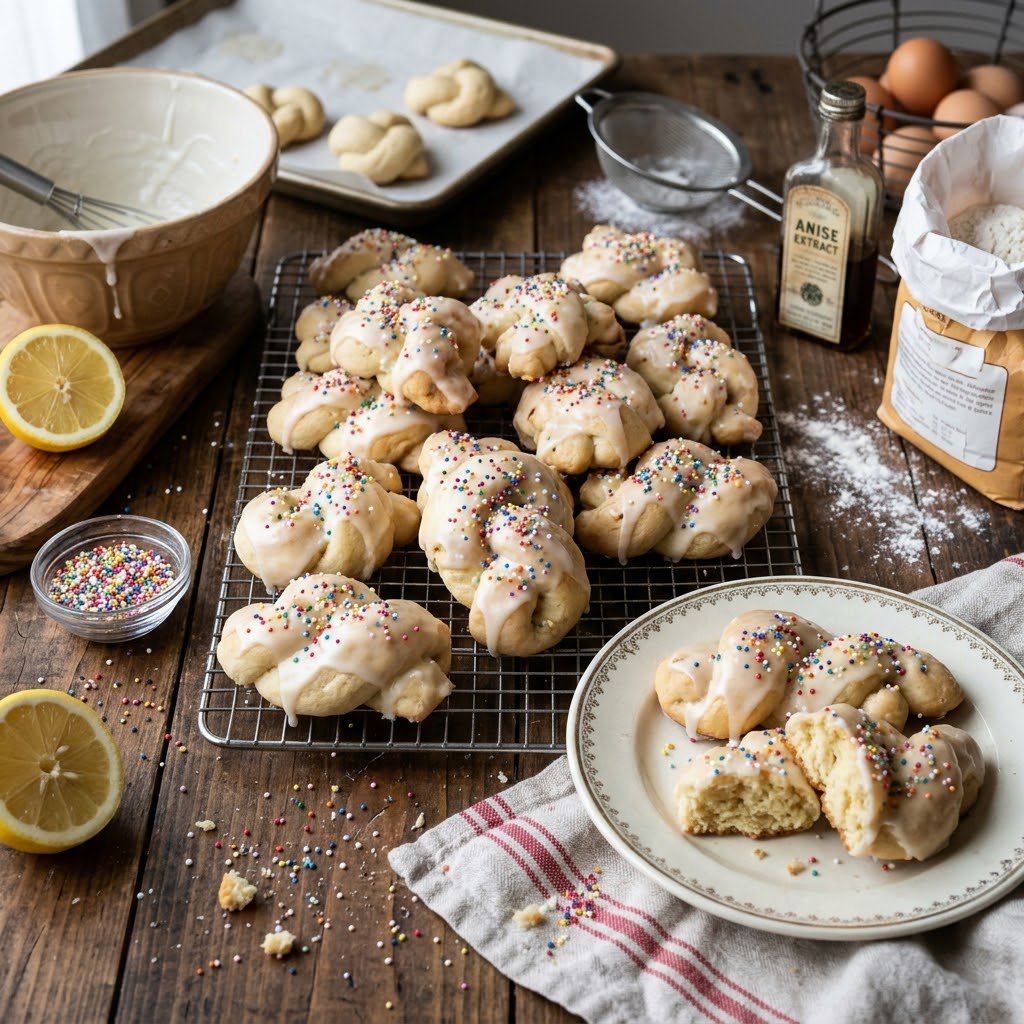
Walk into almost any Italian-American bakery around the holidays and you’ll find a tray of them: soft, pale cookies twisted into little knots, dipped in a shiny white glaze and showered with rainbow nonpareils. This Italian knot cookie recipe makes that exact cookie at home. The texture is closer to a tender little cake than a crisp biscuit, and the flavor is usually anise or lemon, sometimes simply vanilla.
They go by several names. In many families they’re anginetti; others call them Italian love knots, Italian wedding cookies, or just “the iced cookies.” Whatever you call them, the method is the same, and it’s easier than the shaping makes it look. This guide covers the dough, how to tie the knots neatly, how to bake them so they stay soft, and how to get a glaze that sets smooth instead of sliding off.
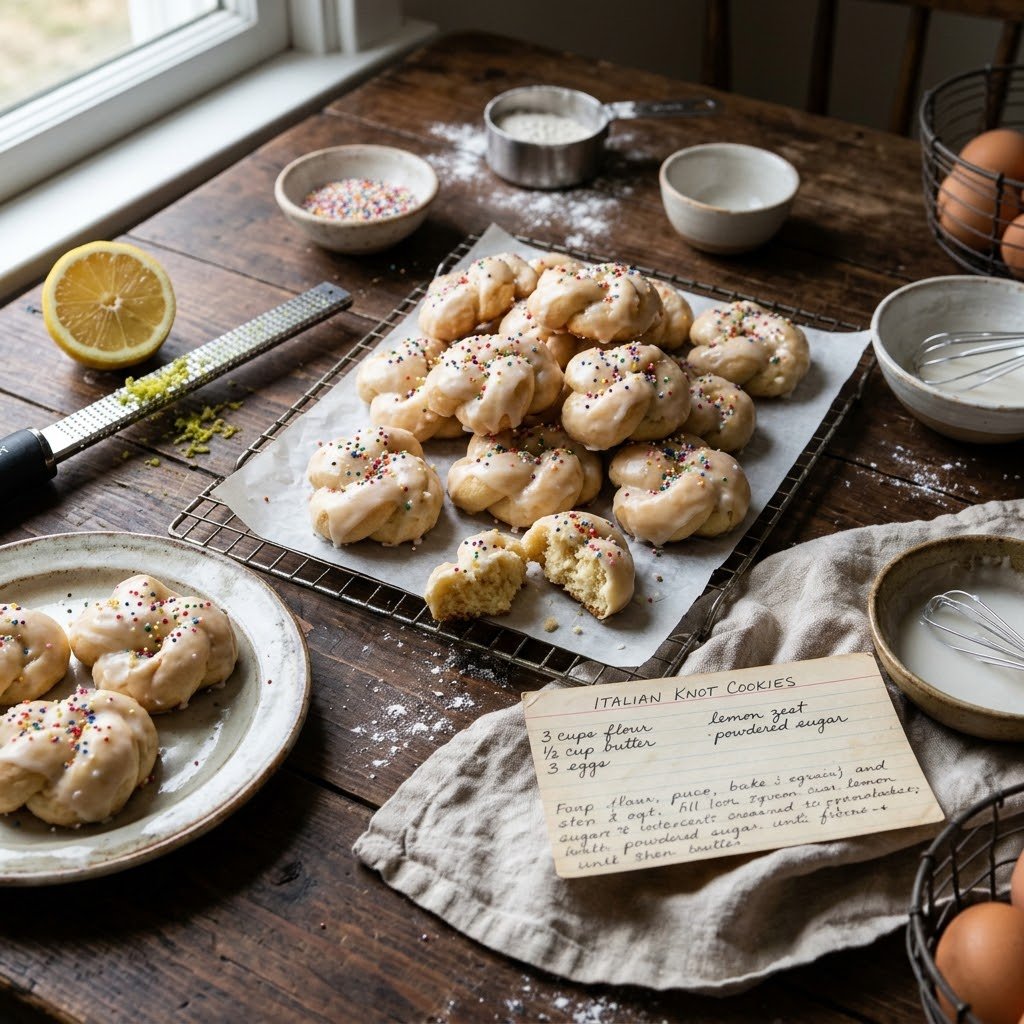
What Are Italian Knot Cookies?
Italian knot cookies are a simple sweet dough leavened with baking powder, rolled into ropes, tied into knots, baked until just set, then glazed. They’re a fixture on Italian-American cookie trays at Christmas, Easter, weddings, christenings, and pretty much any celebration that calls for a dessert table. In Italy, similar glazed cookies appear around Easter in several regions, often flavored with lemon, as this SBS Food piece on Italian Easter biscuits describes.
What makes them different from a regular sugar cookie:
- Texture: soft, light, and slightly bready inside, thanks to a generous amount of baking powder and eggs.
- Sweetness: the cookie itself is only lightly sweet. Most of the sugar is in the glaze.
- Shape: the knot isn’t just for looks. It gives each cookie lots of ridges for the glaze to cling to.
The Italian Knot Cookie Recipe at a Glance
- Makes: about 48 cookies
- Active time: about 40 minutes, mostly shaping
- Chill time: 30 minutes
- Bake: 10 to 12 minutes per sheet at 350°F
- Flavor options: anise, lemon, vanilla, almond, or orange
- Difficulty: easy, though the first few knots take a little practice
Ingredients and What Each One Does
For the cookie dough
- All-purpose flour (4 cups / 500 g): measure it carefully. Too much flour is the most common reason these cookies turn dry and dense. Spoon it into the cup and level it, or better yet, weigh it. King Arthur Baking has a helpful guide to measuring baking ingredients if you’re unsure.
- Baking powder (1 tablespoon): yes, a full tablespoon. It gives the knots their puffy, cake-like crumb.
- Salt (1/4 teaspoon): keeps the cookie from tasting flat.
- Unsalted butter (1/2 cup / 113 g), softened: some older family recipes use shortening or oil. Butter gives better flavor; shortening gives a slightly softer, whiter cookie. Either works.
- Granulated sugar (3/4 cup / 150 g).
- Large eggs (3), at room temperature: cold eggs can make the butter seize and the dough lumpy.
- Whole milk (1/2 cup / 120 ml): keeps the dough soft and pliable.
- Pure vanilla extract (2 teaspoons).
- Anise extract (1 teaspoon) or the zest of 1 large lemon: choose your flavor. Anise is the traditional, licorice-like choice; lemon is brighter and more crowd-friendly.
For the glaze
- Powdered sugar (3 cups / 360 g), sifted.
- Milk (4 to 5 tablespoons): add it a little at a time.
- Flavoring: 1 teaspoon anise extract, or 1 tablespoon fresh lemon juice in place of 1 tablespoon of the milk.
- Rainbow nonpareils: the classic finish. Colored sanding sugar works too.
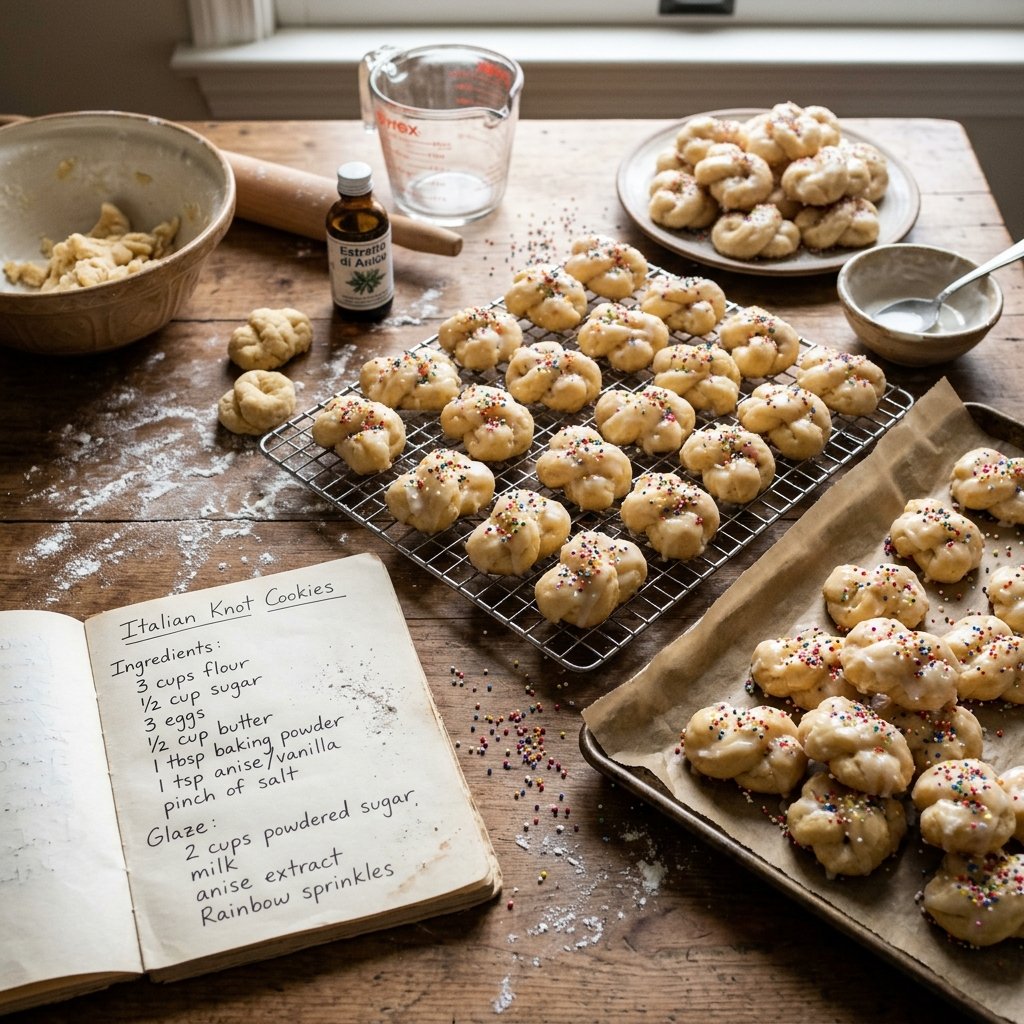
How to Make Italian Knot Cookies
Step 1: Make the dough
Whisk the flour, baking powder, and salt in a bowl. In a separate large bowl, beat the softened butter and sugar with a mixer on medium speed for about 2 minutes, until light and fluffy. Beat in the eggs one at a time, then the vanilla and the anise extract or lemon zest. The mixture may look a little curdled at this point; that’s fine.
On low speed, add about a third of the flour mixture, then half the milk, then another third of the flour, the rest of the milk, and the last of the flour. Mix only until no dry streaks remain. The dough will be soft and sticky, more like a thick batter than a sugar cookie dough.
Step 2: Chill it
Cover the bowl and refrigerate for at least 30 minutes, or up to a day. Chilling firms the butter and lets the flour hydrate, which turns a sticky mess into a dough you can actually roll. Don’t be tempted to fix the stickiness by adding more flour; that’s how you end up with hard cookies.
Step 3: Roll the ropes
Heat the oven to 350°F and line two baking sheets with parchment. Scoop the dough in level tablespoons (about 20 g each). On a very lightly floured surface, roll each piece with your palms into a rope about 6 inches long and as thick as a pencil, slightly thicker in the middle. Keep the rest of the dough in the fridge while you work.
Step 4: Tie the knots
Tie each rope into a loose single knot, just like the first step of tying a shoelace, and tuck the ends underneath. Keep it loose: the cookies puff a lot in the oven, and a tight knot bakes into a round blob. Space them about 2 inches apart.
Step 5: Bake
Bake one sheet at a time for 10 to 12 minutes. The tops should stay pale, almost white, and spring back when pressed; the bottoms should be just barely golden. If the tops are browning, they’re overbaked and will be dry by the next day. Cool on the sheet for 2 minutes, then move to a wire rack and cool completely.
Step 6: Glaze and decorate
Whisk the powdered sugar, flavoring, and 4 tablespoons of milk until smooth. It should be thick enough to coat a spoon and slowly drip off. Add more milk by the half teaspoon if needed. Hold each cooled cookie by the bottom, dip the top into the glaze, let the excess drip off, and set it back on the rack. Add the nonpareils right away, before the glaze starts to set. Let the cookies dry for at least 2 hours, or until the glaze is firm to the touch.
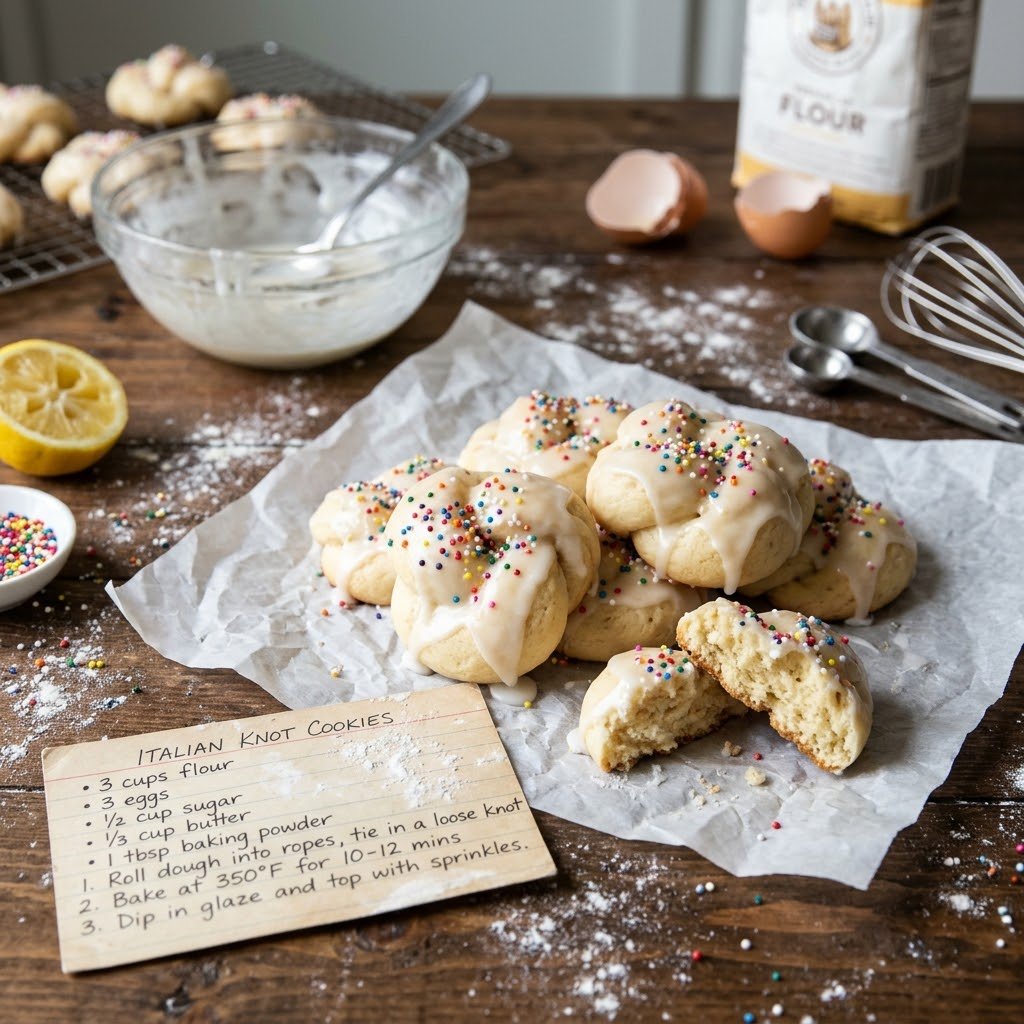
Tips for the Softest Results With This Italian Knot Cookie Recipe
The difference between a bakery-soft knot and a dry one usually comes down to small details rather than the ingredient list.
- Room-temperature everything. Take the butter, eggs, and milk out about an hour before you start. They blend more smoothly and trap more air, which helps the cookies rise.
- Use as little flour on the counter as possible. Every extra dusting gets rolled into the dough. A lightly oiled or slightly damp hand can help instead of flour when the dough sticks.
- Bake one sheet at a time on the middle rack. Two sheets at once often means one overbakes on the bottom.
- Trust the color, not the clock. Ovens vary. Start checking at 9 minutes; you want pale tops and a faint golden edge underneath.
- Store them as soon as the glaze sets. Left out uncovered overnight, these cookies dry out quickly. An airtight tin keeps the crumb tender.
A good rule for any version of this Italian knot cookie recipe: if you’re unsure whether they’re done, pull them a minute early. A slightly underbaked knot stays soft for days; an overbaked one only gets harder.
Three Ways to Shape the Dough
The knot is the classic, but you’ll see a few other shapes on bakery trays. All of them use the same 6-inch rope.
- Single knot: the shape in this recipe. Easy, quick, and holds the most glaze.
- Twist: fold the rope in half and twist the two strands around each other two or three times. Pinch the ends.
- S-shape or coil: roll the rope into a loose snail shape, or curl each end in the opposite direction to make an S.
Whatever shape you choose, keep them the same size on each sheet so they bake evenly.
Glaze Flavor Guide for Your Italian Knot Cookies
Match the glaze to the dough, or mix and match for a varied cookie tray.
| Flavor | In the dough | In the glaze | Finish |
|---|---|---|---|
| Anise (traditional) | 1 tsp anise extract | 1 tsp anise extract | Rainbow nonpareils |
| Lemon | Zest of 1 lemon | 1 tbsp lemon juice + a little zest | Yellow sanding sugar or plain |
| Vanilla | 3 tsp vanilla total | 1/2 tsp vanilla | Rainbow nonpareils |
| Almond | 1/2 tsp almond extract | 1/4 tsp almond extract | Sliced almonds or pastel nonpareils |
| Orange | Zest of 1 orange | 1 tbsp orange juice | Orange sanding sugar |
Almond extract is strong, so use less than you think. If you need a glaze without powdered sugar for another project, see our glaze recipe without powdered sugar.
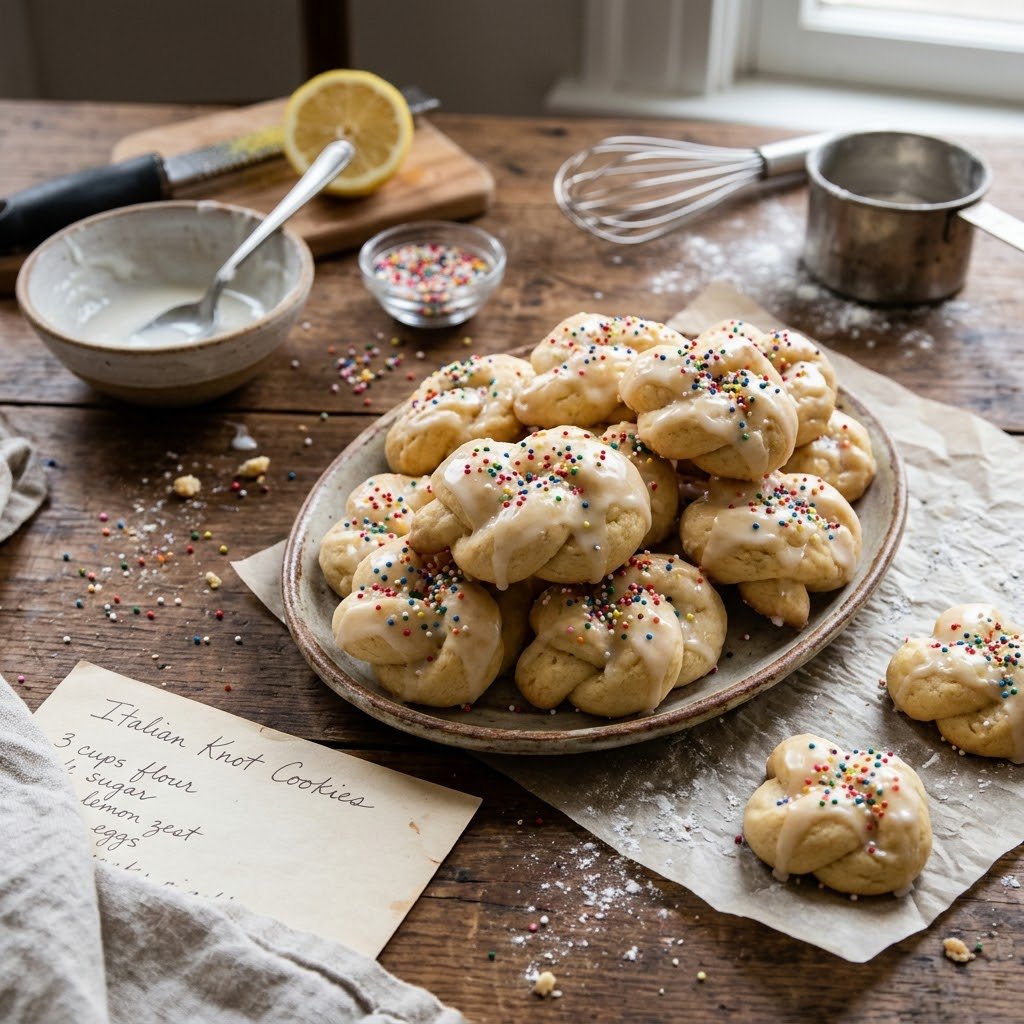
Troubleshooting: Fixing Common Problems
| Problem | Likely cause | Fix |
|---|---|---|
| Dough is too sticky to roll | Not chilled long enough, or the kitchen is warm | Chill another 20 to 30 minutes and work with a small portion at a time. |
| Cookies are dry or hard | Too much flour or overbaked | Weigh the flour and pull the cookies while the tops are still pale. |
| Knots lost their shape | Ropes too thick or knots tied too tight | Roll thinner ropes and tie loose knots with a visible hole in the middle. |
| Glaze is see-through | Glaze too thin, or cookies still warm | Add more powdered sugar and glaze only fully cooled cookies. |
| Glaze cracks or stays sticky | Too thick or too humid | Thin with a few drops of milk; let them dry in a cool, dry room. |
| Sprinkles bleed color | Added too early or glaze too wet | Sprinkle right after dipping and avoid stacking until fully set. |
Making Them Ahead for the Holidays
Because these cookies show up on so many holiday trays, it helps to know how far ahead you can work.
- Dough: refrigerate, well covered, for up to 1 day before shaping.
- Baked, unglazed cookies: freeze in an airtight container for up to 2 to 3 months. Thaw at room temperature, then glaze.
- Glazed cookies: keep in an airtight container at room temperature for 4 to 5 days, with parchment between layers. They’re softest in the first two or three days.
- Freezing glazed cookies: possible, but the glaze can turn tacky as it thaws. Freezing them before glazing gives better results.
Building a full cookie tray? These pair nicely with a classic sugar cookie like our one sugar cookie recipe, the chewy chocolate chip cookies, and something richer such as crème brûlée cookies.

Italian Knot Cookie Recipe FAQ
Are Italian knot cookies the same as anginetti?
Yes, in most Italian-American households the two names refer to the same soft, glazed cookie. Anginetti are often flavored with lemon or anise and may be shaped as knots, twists, or rings.
Do I have to use anise?
No. Anise is traditional, but lemon and vanilla versions are just as common. If anise isn’t your favorite, start with lemon zest in the dough and lemon juice in the glaze.
Can I use anise oil instead of anise extract?
You can, but anise oil is several times stronger than extract. Use just a few drops and taste the glaze before adding more.
Why are my cookies flat instead of puffy?
The most common causes are old baking powder, butter that was too soft or melted, or skipping the chill. Check the date on your baking powder; it loses strength over time.
Can I make them without a mixer?
Yes. Cream the softened butter and sugar with a sturdy wooden spoon until lighter in color, then follow the same steps. It takes a bit more arm work, but the dough doesn’t need heavy kneading.
How do I keep the glaze from dripping everywhere?
Make the glaze thicker than you think you need, dip only the tops, and let the excess drip back into the bowl for a few seconds. Set the cookies on a wire rack over a sheet of parchment to catch drips.
Printable Italian Knot Cookie Recipe
Everything you need in one place, with measurements by volume and weight.
Italian Knot Cookies (Anginetti)
Ingredients
Equipment
Method
- Whisk the flour, baking powder and salt in a bowl. In a large bowl, beat the butter and sugar on medium speed for about 2 minutes until light and fluffy.
- Beat in the eggs one at a time, then the vanilla and anise extract (or lemon zest).
- On low speed, add the flour mixture in three parts, alternating with the milk in two parts, mixing just until no dry streaks remain. The dough will be soft and sticky.
- Cover and refrigerate for at least 30 minutes (up to 1 day).
- Heat the oven to 350°F (175°C) and line baking sheets with parchment. Scoop level tablespoons of dough (about 20 g), roll each into a 6-inch rope and tie into a loose knot, tucking the ends under. Space 2 inches apart.
- Bake one sheet at a time for 10 to 12 minutes, until the tops are pale and spring back and the bottoms are barely golden. Cool 2 minutes on the sheet, then completely on a wire rack.
- Whisk the powdered sugar, flavoring and 4 tablespoons milk into a thick, smooth glaze, adding more milk by the half teaspoon if needed.
- Dip the top of each cooled cookie in the glaze, let the excess drip off, set on the rack and immediately add nonpareils. Let dry at least 2 hours until the glaze is firm.