
Some cakes are built to impress with height or decoration. This one wins on texture. Each forkful is soft, springy and barely sweet, wrapped in a thick layer of glossy white frosting that looks like it was scooped straight out of the sky. This layered cloud cake pairs two tender vanilla chiffon layers with a marshmallow-like seven-minute frosting, swirled on in big, lazy peaks. It’s the kind of cake people go back for a second slice of without really meaning to.
If you’ve tried our classic cloud cake recipe before, think of this as its taller, party-ready cousin. The method is different, the frosting is completely different, and the result is a proper layer cake that still feels light as air. Below, the recipe is broken into three parts (the cake, the frosting and the finish) along with a make-ahead schedule so the whole thing fits comfortably into a busy week.
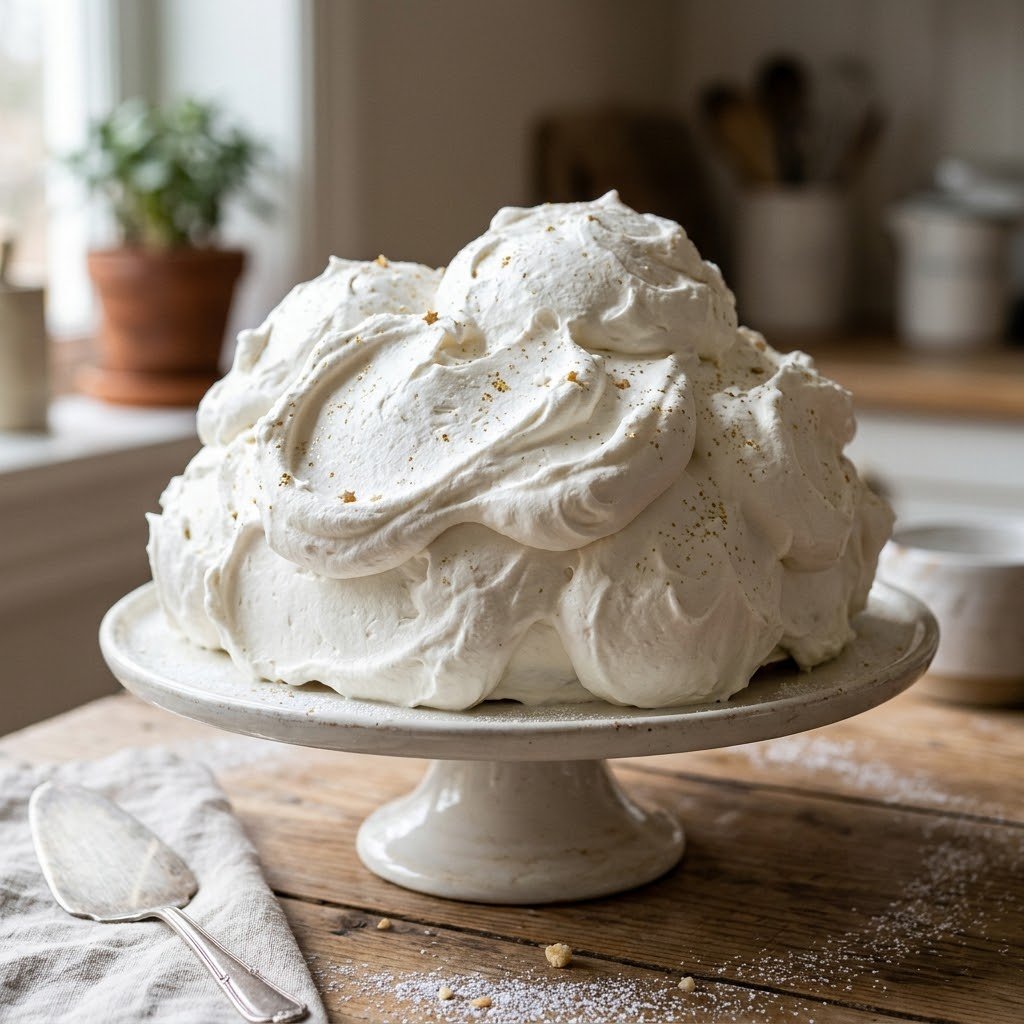
What Makes This Layered Cloud Cake Different?
“Cloud cake” isn’t one fixed recipe. Bakers use the name for anything that feels unusually airy, from fluffy sponges to meringue-topped desserts. In this version, two things earn the name.
The layers are chiffon. Chiffon cake uses oil instead of butter and gets most of its lift from whipped egg whites folded into the batter. Oil stays liquid at room temperature, so the crumb stays soft and moist even straight from the fridge, while the whites give it that springy, open texture. It’s lighter than a butter cake but more tender and forgiving than a pure angel food cake.
The frosting is a cooked meringue. Seven-minute frosting is egg whites and sugar whisked over simmering water until they turn into a thick, shiny, marshmallowy cloud. It holds dramatic swirls and peaks better than whipped cream, it isn’t heavy like buttercream, and it contains no butter at all. If you’ve had a lemon meringue pie, the texture is close to that topping, only softer and more spreadable. This guide to the different types of meringue explains why the cooked versions are the most stable.
Before You Start: Five Things That Matter
Both halves of this layered cloud cake depend on whipped egg whites, so a few small details make the difference between a tall, fluffy cake and a flat one.
- Use a spotless bowl. Any trace of grease or egg yolk stops whites from whipping properly. Wipe the bowl and beaters with a paper towel dampened with a little lemon juice or vinegar before you begin.
- Separate the eggs cold, whip them warm. Cold eggs separate more cleanly, but room-temperature whites whip faster and higher. Separate them first, then let them sit for 20 to 30 minutes.
- Choose cake flour if you can. It has less protein than all-purpose flour, which keeps the crumb fine and tender. No cake flour? Measure 2 1/4 cups all-purpose flour, remove 4 1/2 tablespoons, replace them with cornstarch and sift well.
- Don’t grease the pan sides. Chiffon batter climbs the walls of the pan as it bakes. Line only the bottoms with parchment so the batter has something to cling to.
- Make the frosting last. Seven-minute frosting is at its best right after it’s made. Bake and fully cool the layers first, then whip the frosting just before assembling.
Part One: The Chiffon Cake Layers
The batter comes together in two bowls. One holds the yolks, oil, milk and dry ingredients, which you can mix by hand. The other holds the whites, which you whip to firm peaks and fold in at the end. Here’s how it goes:
Mix the yolk batter
Heat the oven to 350°F (175°C) and line the bottoms of two 8-inch round cake pans with parchment. Sift the cake flour, 1 cup of the sugar, baking powder and salt into a large bowl. In a separate bowl, whisk the oil, egg yolks, milk and vanilla until smooth, then pour the wet mixture into the dry ingredients and whisk just until the batter is smooth and glossy. It will be fairly thick at this point, which is normal.
Whip the egg whites
In a clean bowl, beat the egg whites with the cream of tartar on medium speed until foamy. Increase to medium-high and add the remaining 1/2 cup of sugar a spoonful at a time. Keep beating until the whites are glossy and hold firm peaks that stand up straight with just a slight curl at the tip. Stop there. Overwhipped whites look dry and clumpy, and they’re harder to fold in smoothly.
Fold, don’t stir
Stir about a quarter of the whites into the yolk batter to loosen it. Add the rest and fold gently with a large spatula: cut down through the middle, sweep along the bottom and lift up the side, turning the bowl as you go. Fold until no white streaks remain, but no longer. Every extra stroke knocks out air you worked to build.
Bake and cool upside down (or close to it)
Divide the batter evenly between the pans and smooth the tops. Bake for 25 to 30 minutes, until the tops spring back when pressed lightly and a toothpick in the center comes out clean. Let the cakes cool in their pans for 10 minutes, then run a thin knife around the edges and turn them out onto a wire rack. Peel off the parchment and let the layers cool completely, about 1 hour. The tops may sink very slightly as they cool. That’s normal for chiffon and disappears under the frosting.
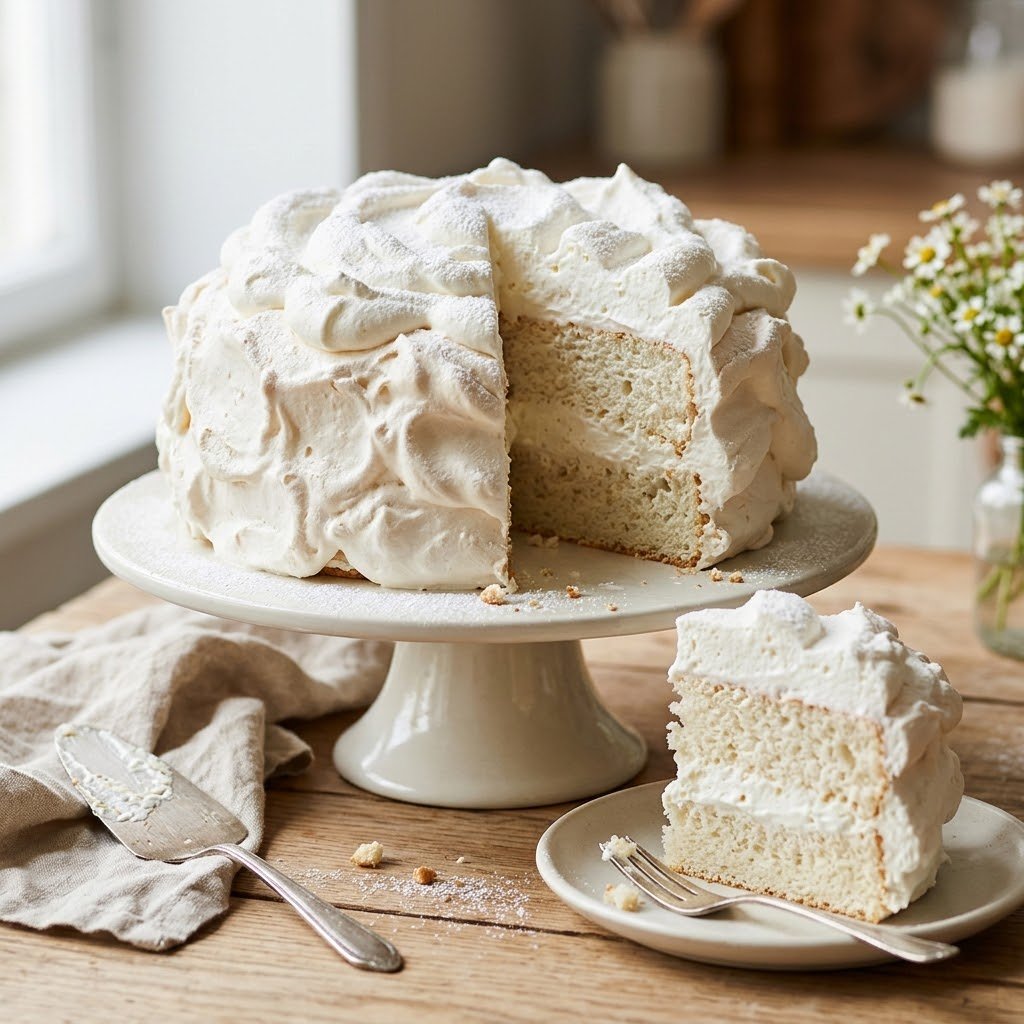
Part Two: The Seven-Minute Cloud Frosting
This is the part that turns a nice vanilla cake into a cloud cake. Seven-minute frosting gets its name from the time it takes to whip over the heat, though it can take anywhere from 6 to 10 minutes depending on your mixer and the size of your pot.
- Set a heatproof bowl over a saucepan with about 2 inches of barely simmering water. The bottom of the bowl shouldn’t touch the water.
- Add the egg whites, sugar, water, cream of tartar and salt to the bowl and whisk briefly by hand to combine.
- Beat with a hand mixer on high speed, moving the beaters around the bowl, until the mixture is thick, bright white and glossy, and holds stiff peaks. An instant-read thermometer should read 160°F (71°C), the temperature FoodSafety.gov lists for egg dishes.
- Take the bowl off the heat, add the vanilla and keep beating for 1 to 2 minutes more, until the frosting is slightly cooled and very thick.
Use it right away. Seven-minute frosting begins to set as it cools, forming a thin, slightly crisp outer skin over a soft, marshmallowy inside. That contrast is part of its charm, but it also means the frosting gets harder to spread the longer it sits in the bowl.
Using a stand mixer instead? Heat the whites, sugar, water, cream of tartar and salt over the simmering water, whisking constantly by hand, until the sugar dissolves and the mixture reaches 160°F. Then transfer the bowl to the stand mixer and whip on high for 5 to 7 minutes until thick and glossy. Technically this makes a Swiss-style meringue, and the result is nearly identical.
Part Three: Assembling the Cloud Cake
The goal here isn’t smooth, sharp edges. It’s soft, generous, uneven swirls, so this is one of the most forgiving cakes you’ll ever decorate.
- Level if needed. If either layer domed, slice off the top with a serrated knife so the cake sits flat.
- Fill. Place the first layer top-side down on a cake stand or plate. Spread about 1 1/2 cups of frosting over it, nearly to the edge.
- Stack. Add the second layer, top-side down, so you have a flat surface on top.
- Cover. Pile the remaining frosting on top and push it over the edges and down the sides with an offset spatula or the back of a spoon.
- Swirl. Press the back of a spoon into the frosting and lift it away in a twisting motion to pull up peaks. Work all over the cake, mixing big swoops with smaller curls.
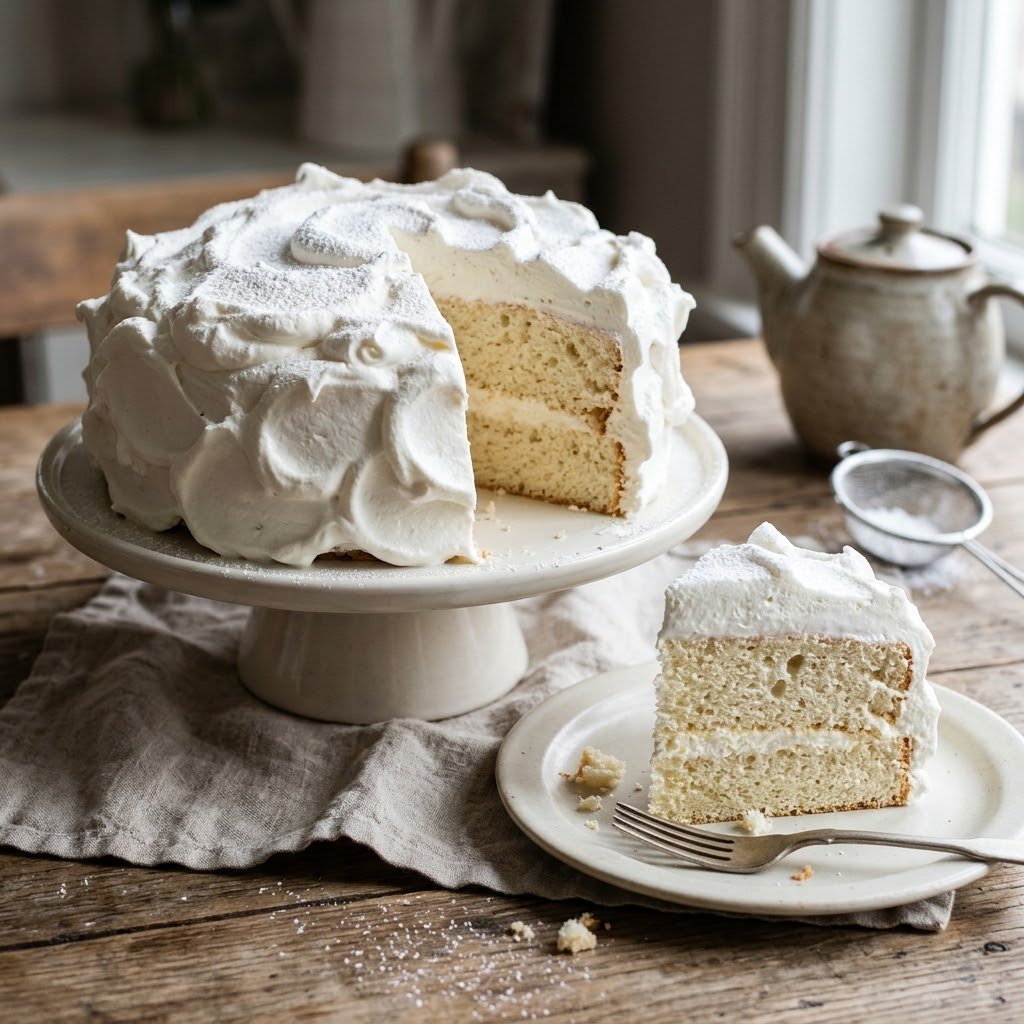
- Finish. A light dusting of powdered sugar through a fine sieve gives it a soft, misty look, just like the cake in the photos.
To cut clean slices, dip a long knife in hot water and wipe it dry between cuts. The meringue will still cling a little, which is part of the fun.
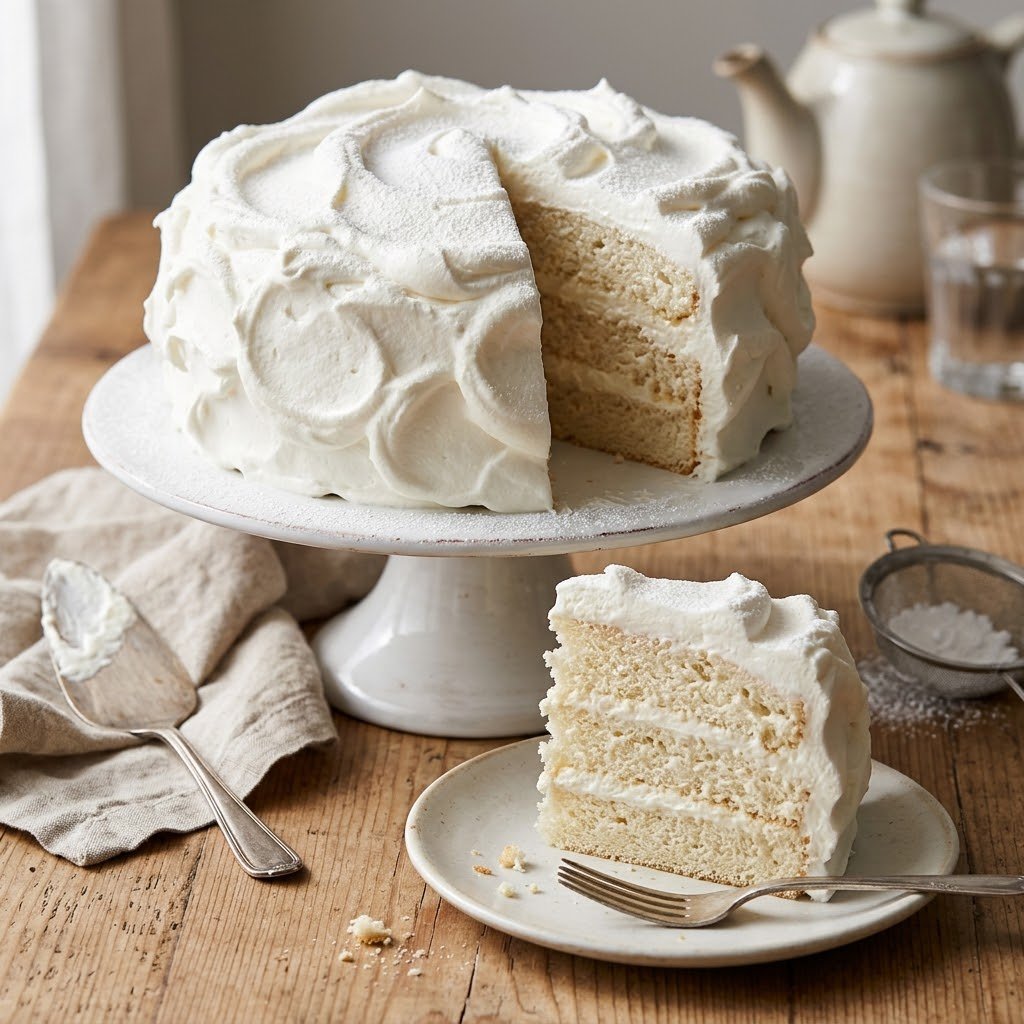
A Stress-Free Timeline for Your Layered Cloud Cake
Everything about this layered cloud cake can be spread out except the frosting, which should be made on the day you serve it. Here’s a schedule that works well for birthdays and gatherings:
| When | What to do | Notes |
|---|---|---|
| Up to 1 month ahead | Bake the chiffon layers and freeze them | Cool completely, wrap each layer tightly in plastic and then foil |
| 1 day ahead | Bake the layers (or move frozen layers to the fridge) | Wrapped layers keep well overnight at room temperature |
| 2 to 6 hours before serving | Make the frosting and assemble | The frosting forms its pretty outer crust as it sits |
| Right before serving | Dust with powdered sugar and add any toppers | Sugar dissolves if added too early |
Frosting Options Compared
Seven-minute frosting gives the most dramatic cloud effect, but it isn’t your only choice. Here’s how it stacks up against two popular alternatives:
| Frosting | Texture | Stability | Best for |
|---|---|---|---|
| Seven-minute frosting | Marshmallowy, light, glossy | Holds a few hours at room temperature; best eaten the same day | The classic cloud look and a less sweet finish than buttercream |
| Stabilized whipped cream | Very light, creamy, fresh | Must stay refrigerated | Summer cakes with fresh berries |
| Swiss meringue buttercream | Silky, rich, buttery | Very stable; keeps several days in the fridge | Making the cake further ahead or traveling with it |
If you go the whipped cream route, beat 2 cups of cold heavy cream with 1/2 cup powdered sugar and 4 ounces of cold mascarpone until stiff. The mascarpone helps the cream hold its shape. It’s a lovely option alongside the berries in our blueberry lemon mascarpone cake.
Variations on This Layered Cloud Cake
Lemon cloud cake
Add the finely grated zest of two lemons to the yolk batter and replace 2 tablespoons of the milk with fresh lemon juice. Spread a thin layer of lemon curd between the cake layers before adding the frosting. Bright, sharp lemon against the sweet meringue is a classic pairing for a reason.
Berry cloud cake
Scatter fresh raspberries or sliced strawberries over the frosting in the middle layer, or spread a few spoonfuls of jam there instead. Homemade blackberry preserves work especially well and add a pretty purple stripe when you slice the cake.
Night-sky cloud cake
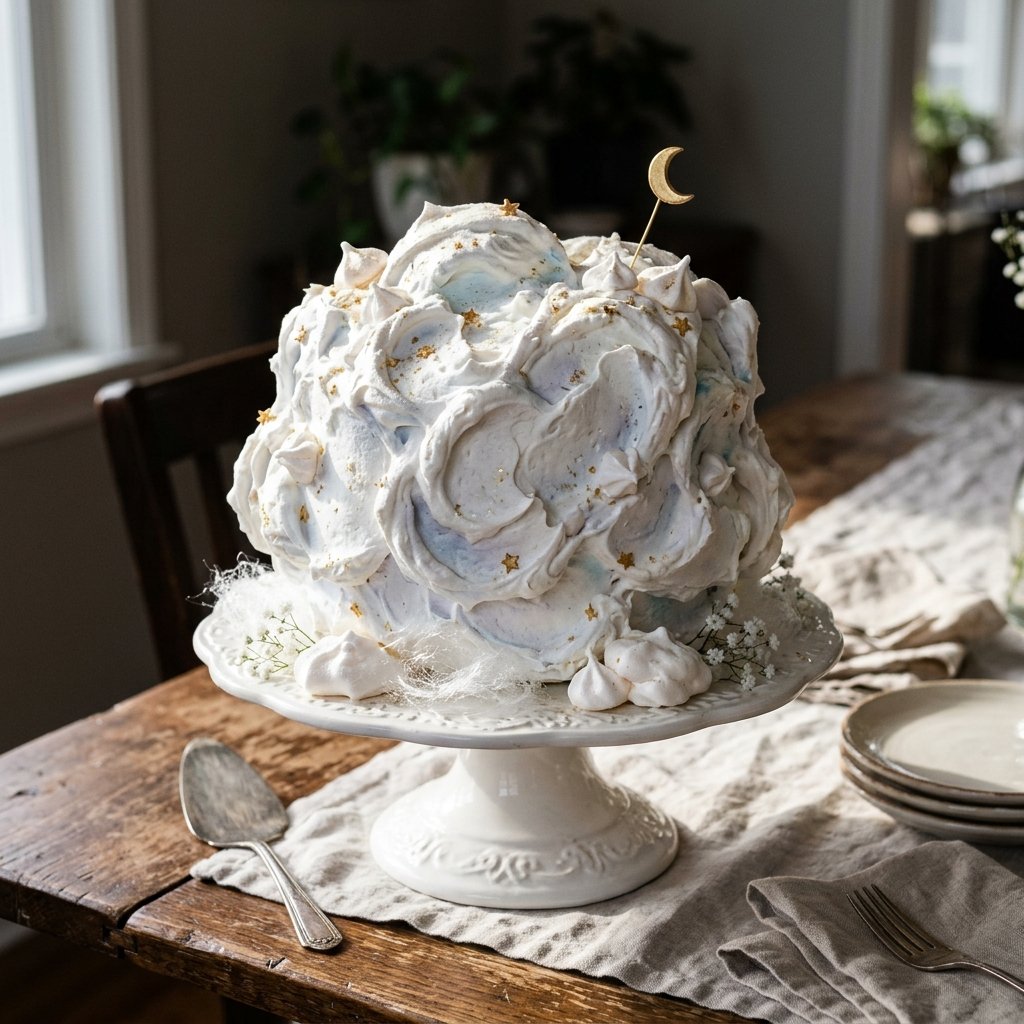
This is the most playful take on a layered cloud cake. For a birthday or baby shower, set aside a third of the frosting and tint it the palest blue with a toothpick-tip of gel food coloring. Dollop the blue and white frostings over the cake together, then swirl them just once or twice so they stay separate. Finish with edible gold stars and a small moon topper.
Coconut cloud cake
Replace the vanilla in the frosting with 1/2 teaspoon coconut extract and press sweetened shredded coconut all over the outside of the finished cake. It turns into something close to an old-fashioned coconut layer cake, only lighter.
Troubleshooting: If This Happens, Try This
Most problems with a layered cloud cake come down to the egg whites, and nearly all of them are easy to fix next time.
The layers came out dense or rubbery. The whites were underwhipped or the batter was overmixed after folding. Next time, beat the whites until they hold firm peaks and fold just until the streaks disappear.
The cake shrank a lot as it cooled. A little shrinkage is normal. A lot usually means the cake was underbaked or the pans were greased, so the batter couldn’t grip the sides. Bake until the top springs back and leave the pan sides ungreased.
The frosting won’t thicken. It needs more time or more heat. Keep beating over the simmering water; it can take up to 10 minutes. Also check that no yolk slipped into the whites.
The frosting is grainy. The sugar didn’t fully dissolve. Whisk it with the whites for a minute before you start the mixer and make sure the mixture gets hot enough.
The frosting is weeping or sliding. Seven-minute frosting doesn’t like humidity or long waits. Assemble the cake within a few hours of serving, and keep it away from steamy kitchens or direct sun.
Serving and Storing
Cloud cake is lovely on its own with coffee or tea, and even better with a handful of fresh berries on the side. For a dessert table, it sits nicely next to something rich and fruity, such as our strawberry cheesecake lush, or a homey Amish shortcake.
A cake frosted with seven-minute frosting is best eaten the day it’s made. Keep it at cool room temperature, under a cake dome, for up to 6 hours. Leftovers can be covered loosely and refrigerated for up to 2 days. The frosting will lose some of its fluff and may weep slightly, but the chiffon stays soft thanks to the oil. The frosted cake doesn’t freeze well, so freeze only the unfrosted layers.
You’ll also end up with two leftover egg yolks from the frosting. Stir them into a batch of lemon curd, custard or homemade pudding so nothing goes to waste.
Layered Cloud Cake FAQ
Is this the same as Japanese cotton cake?
No. Japanese cotton cakes are usually baked in a water bath and often include cream cheese, which gives them a jiggly, custardy texture. This cloud cake is a chiffon layer cake: springy, fluffy and sturdy enough to stack and frost.
Can I bake this in a 9×13-inch pan?
Yes. Line the bottom with parchment, leave the sides ungreased and bake for 30 to 35 minutes. Cool it in the pan, then pile the frosting on top for an easy sheet cake.
Is seven-minute frosting safe to eat?
When the egg whites are heated to 160°F (71°C) while whipping, they’re cooked to the temperature recommended for egg dishes. An instant-read thermometer takes out the guesswork. You can also use pasteurized egg whites.
Can I make the cake less sweet?
You can reduce the sugar in the cake layers by 2 to 3 tablespoons without hurting the texture. Cutting the frosting sugar is riskier, since the sugar is what keeps the meringue thick and stable.
Why use oil instead of butter?
Oil keeps the cake soft and moist at any temperature, and it doesn’t weigh down the whipped whites the way creamed butter can. That’s what gives chiffon its light, almost bouncy crumb.
Ready to Bake Something Light?
This layered cloud cake asks for a bit of care with the egg whites, but nothing about it is difficult. Whip the whites properly, fold gently, let the layers cool completely and make the frosting just before you build the cake. Do that, and you’ll have a tall, snowy cake with a soft, springy crumb that looks far more impressive than the effort it took. The full recipe, with weights and timings, is in the card below.
Layered Cloud Cake
Equipment
- Two 8-inch round cake pans
- Parchment paper
- Hand mixer or stand mixer
- Heatproof bowl and saucepan
- Instant-read thermometer
- Offset spatula
- Wire cooling rack
Ingredients
Chiffon cake layers
- 2 1/4 cups cake flour sifted (270 g)
- 1 1/2 cups granulated sugar divided: 1 cup + 1/2 cup (300 g total)
- 1 tbsp baking powder
- 1/2 tsp fine salt
- 1/2 cup neutral oil such as canola or vegetable (120 ml)
- 6 large eggs separated, at room temperature
- 3/4 cup whole milk room temperature (180 ml)
- 2 tsp vanilla extract
- 1/2 tsp cream of tartar
Seven-minute frosting
- 4 large egg whites room temperature
- 2 cups granulated sugar (400 g)
- 1/2 cup water (120 ml)
- 1/2 tsp cream of tartar
- 1 pinch salt
- 2 tsp vanilla extract
- powdered sugar for dusting, optional
Instructions
Bake the chiffon layers
- Heat the oven to 350°F (175°C). Line the bottoms of two 8-inch round pans with parchment; do not grease the sides.
- Sift the cake flour, 1 cup of the sugar, baking powder and salt into a large bowl. In another bowl, whisk the oil, egg yolks, milk and vanilla, then whisk into the dry ingredients until smooth.
- In a clean bowl, beat the egg whites and cream of tartar until foamy. Gradually add the remaining 1/2 cup sugar and beat to firm, glossy peaks.
- Stir a quarter of the whites into the batter to loosen it, then gently fold in the rest just until no streaks remain.
- Divide between the pans and bake 25 to 30 minutes, until the tops spring back and a toothpick comes out clean. Cool 10 minutes in the pans, loosen the edges, turn out onto a rack, peel off the parchment and cool completely.
Make the frosting
- Set a heatproof bowl over a pan of barely simmering water. Add the egg whites, sugar, water, cream of tartar and salt and whisk briefly.
- Beat with a hand mixer on high for 6 to 10 minutes, until thick, glossy and holding stiff peaks, and the mixture reaches 160°F (71°C).
- Remove from the heat, add the vanilla and beat 1 to 2 minutes more. Use right away.
Assemble
- Level the layers if needed. Place one layer on a cake stand and spread with about 1 1/2 cups frosting.
- Top with the second layer, then cover the top and sides with the remaining frosting. Use the back of a spoon to pull up swirls and peaks.
- Dust lightly with powdered sugar just before serving, if you like.